Short answer: use ribbon (mass fusion) splicing on high-count ribbon cables — typically 144 fibres and above, and almost always on 864F to 6,912F data centre trunks. Use single-fibre fusion splicing for loose-tube cables, pigtails, repairs, mixed infrastructure and low-count links where the lowest possible loss on every individual fibre matters most.
What is single-fibre fusion splicing?
Single-fibre fusion splicing joins one fibre to another at a time. Each fibre is stripped, cleaned and cleaved, then a core-alignment splicer images both fibres, aligns their cores and fuses them with an electric arc. The joint is protected with a heat-shrink sleeve and stored in a splice tray.
Because every fibre is aligned individually, core-alignment single-fibre splicing gives the lowest and most consistent splice loss. It works with any cable construction — loose tube, tight buffered, pigtails — and with mixed fibre types.
What is ribbon (mass fusion) splicing?
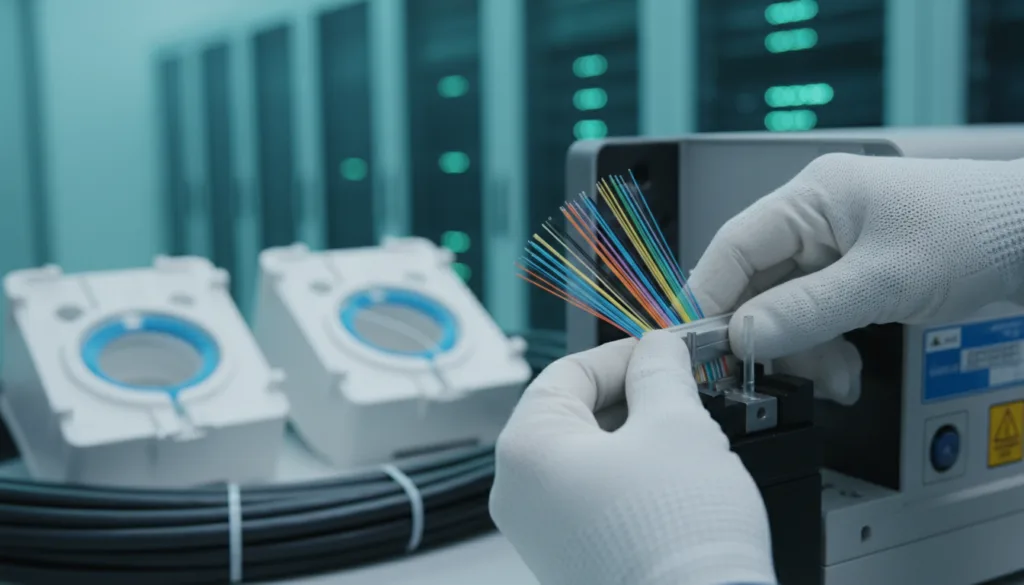
In a ribbon cable, fibres are bonded side by side into flat ribbons, usually of 12 fibres in the TIA-598 colour sequence. Mass fusion splicing strips, cleans and cleaves the entire ribbon as one unit, then fuses all 12 fibres in a single arc cycle using a ribbon splicer.
Rollable (or “spider-web”) ribbon is a newer variant where fibres are bonded only intermittently, so the ribbon can be rolled into a tight bundle. It allows far more fibres in a smaller cable diameter and can still be mass-fusion spliced after the fibres are laid flat in a holder.
Side-by-side comparison
| Single-fibre splicing | Ribbon / mass fusion splicing |
|---|
| Fibres per cycle | 1 | Up to 12 (or 24 on some splicers) |
| Typical use | Loose-tube cables, pigtails, repairs, low-count links | High-count ribbon trunks, data centre and FTTH backbones |
| Splice loss | Lowest — each core individually aligned | Slightly higher on average, but well within typical budgets |
| Programme time | Scales with every fibre | Dramatically shorter on high fibre counts |
| Tray density | One sleeve per fibre | One sleeve per ribbon — denser trays and closures |
| Equipment | Core-alignment splicer, single-fibre cleaver | Ribbon splicer, ribbon cleaver, thermal stripper, fibre holders |
| Skill focus | Clean preparation of every fibre | Ribbon identification and handling at scale |
Time: where ribbon splicing wins
The advantage of ribbon splicing grows with fibre count. A 3,456-fibre cable contains 288 twelve-fibre ribbons, so a ribbon team performs 288 splice cycles per joint instead of 3,456. Preparation, sleeve heating and tray management shrink in the same proportion. On inter-hall and campus trunks, that is the difference between days and weeks per joint.
The time saving only appears if the ribbon work is organised: tubes and ribbons identified correctly, a splice matrix agreed up front, and a preparation engineer feeding the splicer so it is never waiting.
Loss: where single-fibre splicing wins
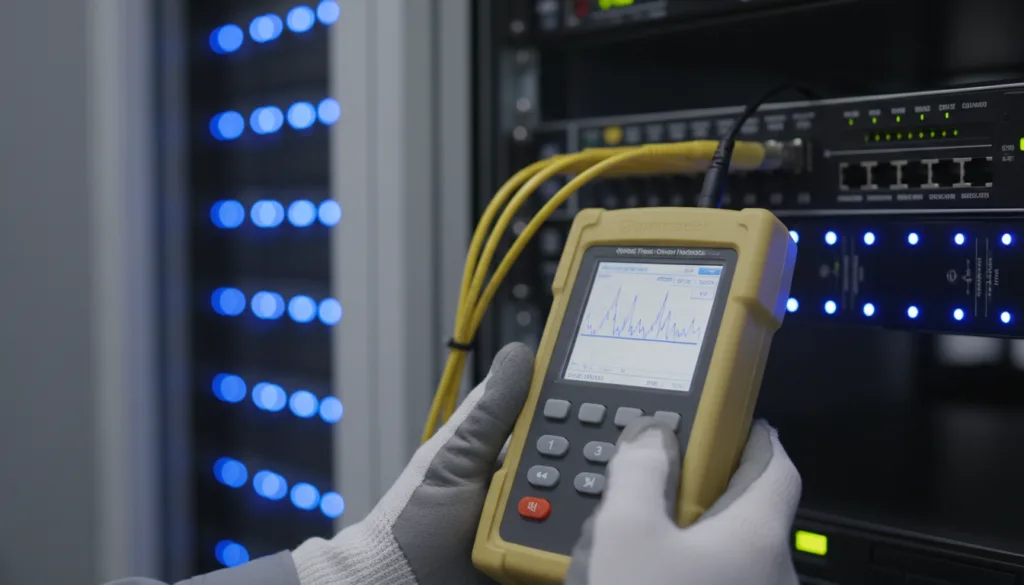
A ribbon splicer aligns the ribbon as a whole, so it cannot correct each fibre’s core position individually. Average loss is therefore slightly higher than with core-alignment single-fibre splicing. In practice, well-made mass fusion splices sit comfortably inside data centre loss budgets — but they should always be verified with bi-directional OTDR testing rather than trusting the splicer’s estimate.
Where a link has a very tight budget — long single-mode routes, multiple joints, or high-speed optics with little margin — single-fibre splicing of critical fibres can still be the right call.
Cost: it depends on fibre count
Ribbon splicers and their accessories cost more than single-fibre kits, and a ribbon team is usually two engineers. On low fibre counts that overhead is not worth it. On high-count cables the labour saving outweighs the equipment cost very quickly, which is why hyperscale and colocation projects specify ribbon cables and mass fusion splicing as standard.
When to choose each method
Choose ribbon splicing when…
- The cable is ribbon or rollable ribbon construction
- Fibre counts are high — inter-hall, campus or DCI trunks
- Programme time and tray density matter
- The loss budget has normal margins
Choose single-fibre splicing when…
- The cable is loose tube or tight buffered
- You are splicing pigtails into ODFs or patch panels
- You are repairing a few fibres after damage
- Every fibre needs the absolute lowest loss
Common mistakes on ribbon jobs
- Poor ribbon identification — mixing up tubes or ribbons is the costliest error on high-count cable. Agree the colour code and allocation before opening the cable.
- Dirty or damaged ribbon preparation — a single bad fibre in a ribbon means re-preparing all twelve.
- Skipping verification — the splicer’s estimate is not a test result. Bi-directional OTDR is the only reliable check.
- Poor tray management — ribbon sleeves must be seated correctly to avoid bend loss later.