Why polarity matters: every optical link must connect a transmitter at one end to a receiver at the other. With duplex LC links that is one fibre pair. With MPO connectors carrying 8, 12 or 24 fibres, the positions must line up across trunks, cassettes and patch cords — and the polarity type of each component decides whether they do.
The three MPO trunk types
An MPO connector has a key on one side of its body. Fibre positions are numbered 1 to 12 (for a 12-fibre connector) across the end-face. The three trunk types defined in TIA-568 differ in how positions map from one end to the other:
| Type | Connector keys | Position mapping |
|---|
| Type A — straight | Key up to key down | 1→1, 2→2 … 12→12 |
| Type B — reversed | Key up to key up | 1→12, 2→11 … 12→1 |
| Type C — pair-flipped | Key up to key down | 1→2, 2→1, 3→4, 4→3 … |
The three connectivity methods
A complete channel is more than a trunk. TIA-568 defines connectivity methods that combine a trunk type with matching adapters, cassettes and patch cords so that, end to end, transmit always meets receive.
Method A
Uses a Type A straight trunk with key-up to key-down adapters. Because positions are not flipped in the trunk, the flip has to happen in the patch cords: a standard A-to-B duplex cord at one end and an A-to-A cord at the other. It is simple to install, but the two ends need different patch cords — a common source of mistakes.
Method B
Uses a Type B reversed trunk with key-up to key-up adapters. The flip happens in the trunk, so standard A-to-B patch cords can be used at both ends. Method B is widely used for parallel optics such as 40G/100G SR4 and 400G DR4, because the position reversal lines up transmit and receive lanes directly.
Method C
Uses a Type C pair-flipped trunk. Each fibre pair is crossed inside the trunk, so standard A-to-B duplex cords work at both ends for duplex applications. It is less suited to parallel optics, where lanes span the whole connector rather than adjacent pairs.
Duplex vs parallel optics
For duplex applications (10G, 25G, 100G over LC pairs), MPO trunks feed cassettes that break out to LC ports — any method works if every component matches. For parallel optics, the transceiver itself has an MPO port and uses several fibres in each direction. Here the trunk and MPO patch cords must deliver the transmit lanes to the receive lanes exactly, which is why choosing the method — and sticking to it across the site — is so important.
Pinned vs unpinned
MPO connectors are either pinned (male, with two guide pins) or unpinned (female). A mated pair must be one of each. Trunks are typically pinned where they plug into cassettes or adapters, and transceivers usually have pinned ports, so patch cords to optics are normally unpinned. Mating two pinned connectors damages the guide pins; mating two unpinned ones gives a misaligned, high-loss joint.
How to troubleshoot an MPO polarity problem
- Inspect and clean first — contamination causes far more failures than polarity. Use a multi-fibre inspection probe on every end-face.
- Identify each component — trunk type, cassette or adapter type, patch cord type, pinned or unpinned.
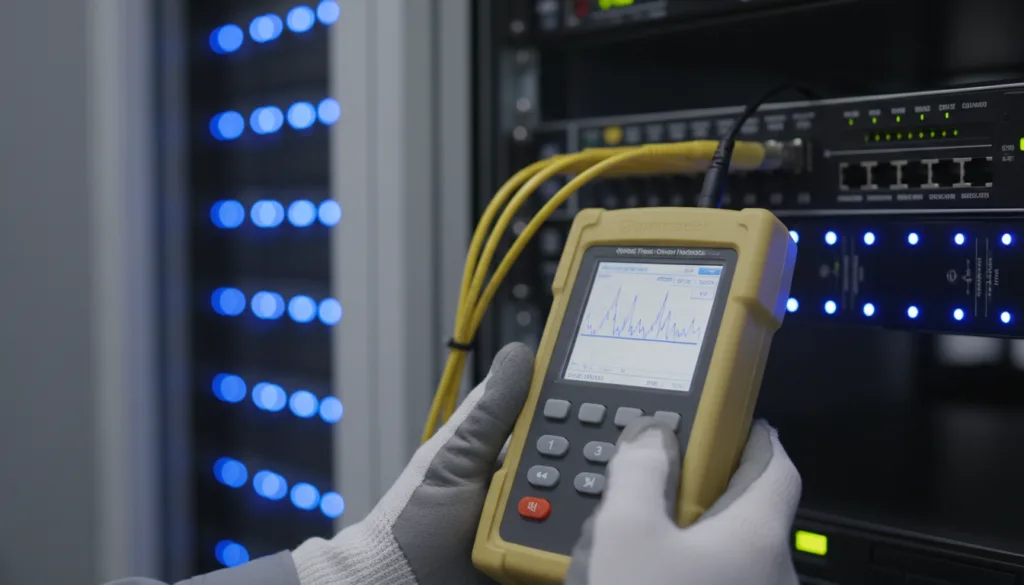
- Test the channel with an MPO tester that maps fibre positions end to end and reports polarity and loss per lane.
- Fix the mismatch — usually by swapping a patch cord or cassette to restore the intended method.
- Document the method on the rack and in records so the next engineer does not undo it.